ASML
TWINSCAN NXE:3100
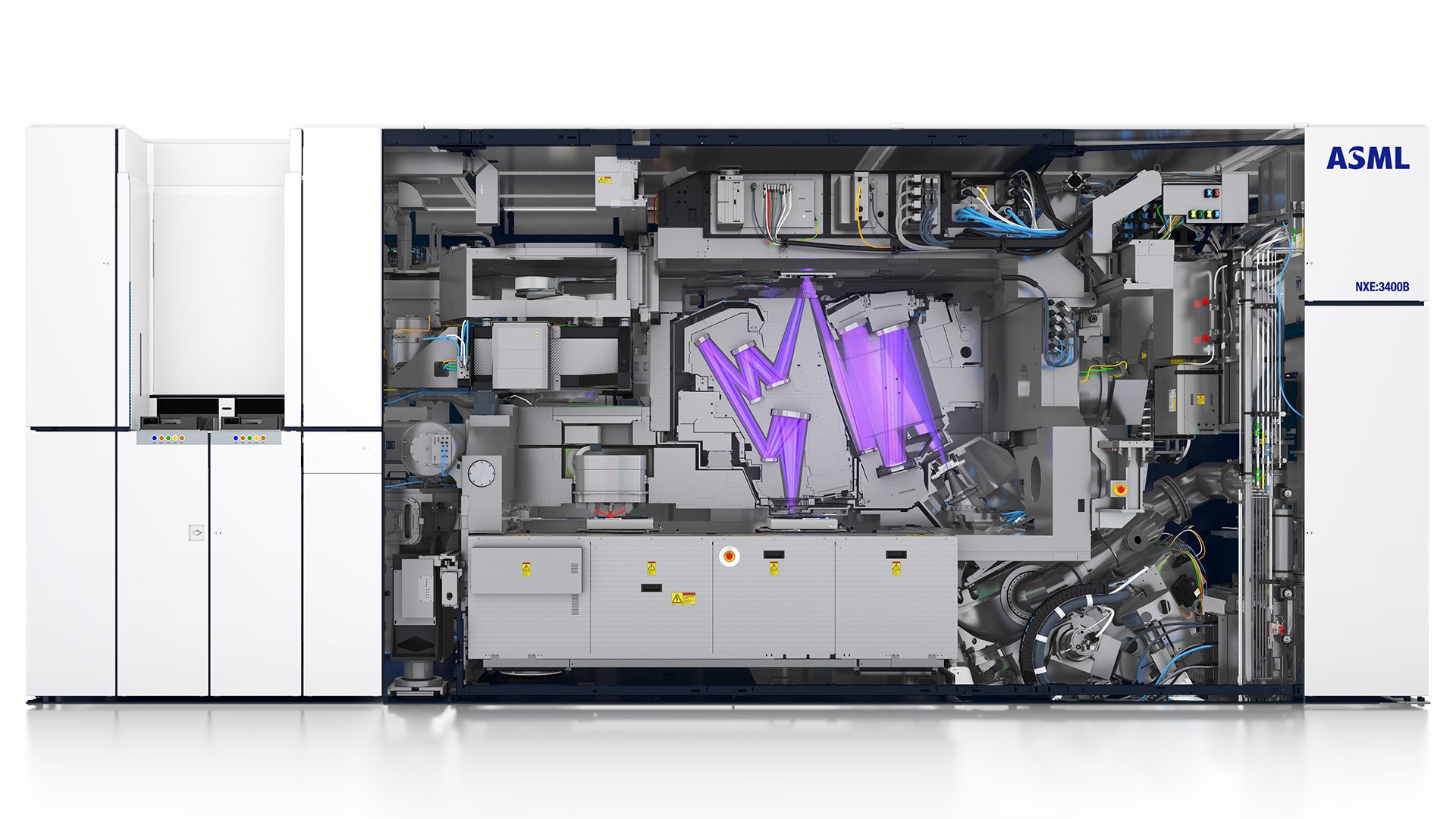
The TWINSCAN NXE:3100 is a pre-production extreme ultraviolet (EUV) lithography system from ASML. The NXE:3100 was the first system in the NXE family to be shipped, in 2010. As an NXE system, it uses a 13.5 nm EUV light source and has a numerical aperture of 0.33.[1]
Introduced
2010
Optics
13.5 nm (EUV)[1]
What it is
The system is designed to print the most intricate layers of a chip, with other layers typically handled by deep ultraviolet (DUV) systems.[1]
How it works
EUV lithography systems use light with a wavelength of 13.5 nm to print microchip patterns, a wavelength that is almost in the x-ray range.[1]
In EUV operation, a CO2 laser fires two separate laser pulses at a fast-moving drop of tin, vaporizing the tin and generating EUV light, with the process occurring up to 50,000 times per second.[1]
Unlike DUV systems, EUV systems use several multilayer mirrors instead of lenses to guide the EUV light to the wafer, shrinking the reticle pattern by a factor of four.[1]
Because EUV light is absorbed by air, the entire light path and everything it interacts with, from source to wafer, must be in a high vacuum.[1]
Where it fits in the process flow
In the fab process flow, EUV systems like the NXE:3100 are used to print the foundation layers of advanced chips, while DUV systems handle the less critical layers.[1]
Applications
EUV lithography systems are used to print the most intricate layers of a chip, such as those for 7 nm, 5 nm, and 3 nm logic nodes, as well as leading-edge DRAM nodes.[1]
Chips made with EUV lithography enable applications such as smart technology, augmented reality, and artificial intelligence, among others.[1]
What do the numbers mean?
Optics & imaging3
Configuration & options1
Vintage & configurations
- 2010First shipment (pre-production)[1]
First TWINSCAN NXE:3100 shipped to a major customer
What replaced it?
Related models
- successorASML TWINSCAN NXE:3300— Pre-production EUV system shipped in 2010, preceding the production NXE:3300source[1]
Where are the manuals?
Generated from public-source data on file. Enter your email to access — nothing is published; details are routed privately.
Not publicly documented
Field notes
No research found yet — worked with this tool? Share what you know.
Frequently asked questions
What is the wavelength of light used by the NXE:3100?
The NXE:3100 uses extreme ultraviolet (EUV) light with a wavelength of 13.5 nm.[1]
What is the numerical aperture of the NXE:3100?
The NXE:3100 has a numerical aperture (NA) of 0.33.[1]
How does the NXE:3100 generate EUV light?
The NXE:3100 generates EUV light by firing a CO2 laser at fast-moving tin drops, vaporizing them to produce EUV light, at a rate of up to 50,000 times per second.[1]
Does the NXE:3100 use lenses or mirrors to focus light?
The NXE:3100 uses multilayer mirrors instead of lenses to guide EUV light to the wafer, shrinking the reticle pattern by a factor of four.[1]
What is the purpose of the high vacuum in the NXE:3100?
The high vacuum is required because EUV light is absorbed by air, so the entire light path from source to wafer must be in vacuum.[1]
What type of layers is the NXE:3100 typically used to print?
The NXE:3100 is used to print the most intricate layers of a chip, with other layers printed using DUV systems.[1]
Not publicly documented
The following facts about the TWINSCAN NXE:3100 are absent from this record as of this revision. First-hand knowledge or a citation closes a gap; every submission is reviewed before publication.
No publicly documented variants, configuration options, or revision breakpoints of the TWINSCAN NXE:3100 are on record.
Answerable by: an OEM product catalog or an engineer who ordered or specified the tool
The control-system platform and OS era of the TWINSCAN NXE:3100 are not on record.
Answerable by: an engineer who operated it or OEM installation records
No publicly documented failure modes or field errata for the TWINSCAN NXE:3100 are on record.
Answerable by: a field service engineer, process engineer, or maintenance technician
The process node or technology generation of the TWINSCAN NXE:3100 is not on record.
Answerable by: an OEM datasheet or a fab qualification report
No publicly documented compatible parts, consumables, or accessories for the TWINSCAN NXE:3100 are on record.
Answerable by: an OEM parts catalog or a service engineer
No research found yet — worked with this tool? Share what you know.
Sources & citations
Sources (1)Every fact above is drawn from these public sources
- [1]asml.com — asml.comasml.com
Last updated Sep 22, 2026.
Compare with similar tools
View all →Brooks 017-0146-01 is a prealigner manufactured by Brooks.
The EVG 101 is an advanced resist processing system for spin or spray coating and developing of wafers up to 300 mm.
